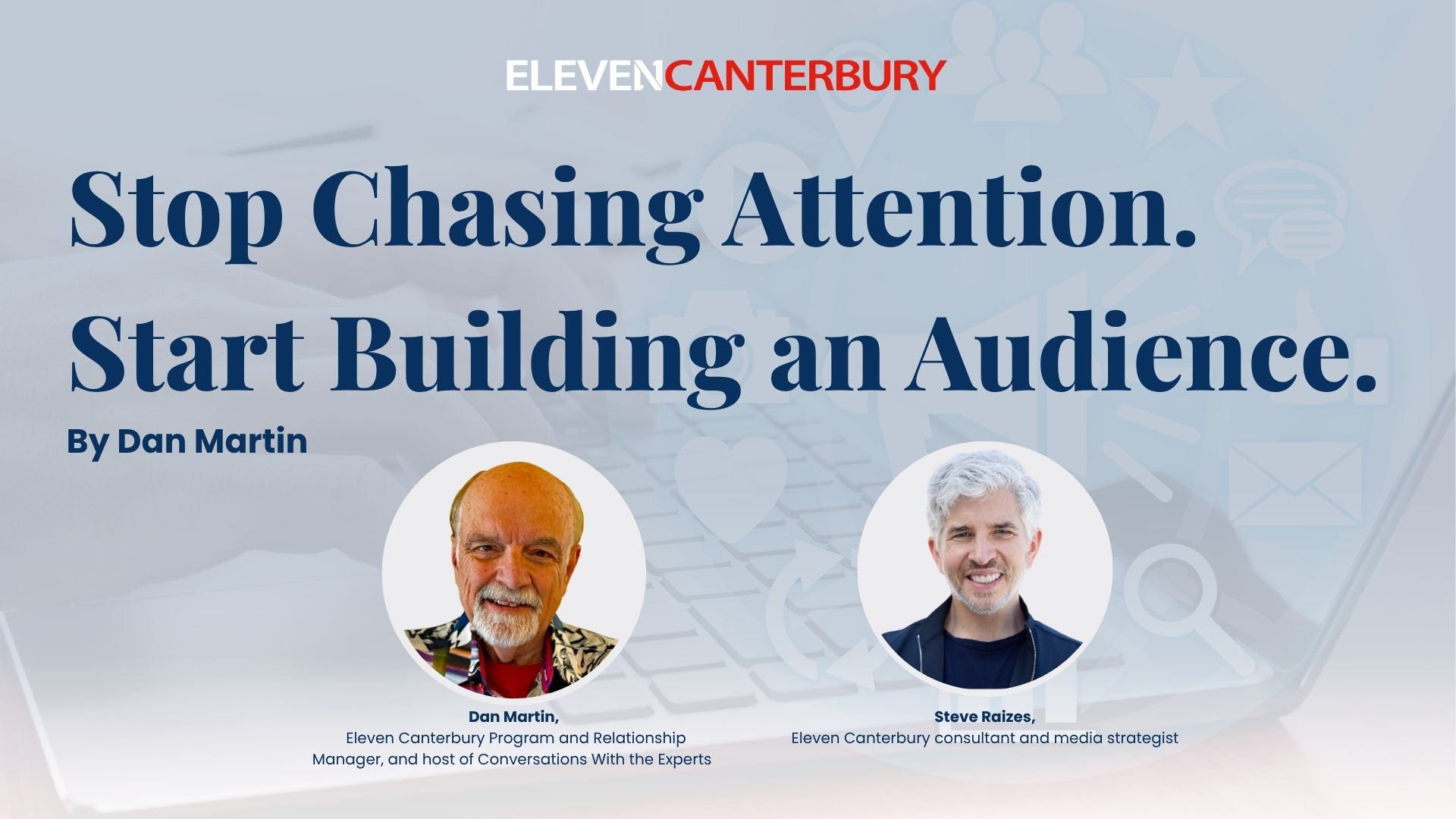
Stop Chasing Attention. Start Building an Audience.
By Dan Martin
Every organization wants attention. More importantly, they want to keep it. But we’re bombarded with so much information, entertainment, and distraction from every direction that capturing attention is difficult. Keeping it is even harder.
Every day, organizations compete not only with other brands but also with streaming services, podcasts, social media, gaming, news, email, text messages, work, family, and everything else vying for people’s time. Simply launching another marketing campaign is no longer enough to cut through the noise.
Steve Raizes, an Eleven Canterbury consultant and media strategist, recently joined me for an episode of Conversations With the Experts. Steve has spent 24 years building communications and content strategies at Paramount, including work across brands like Comedy Central.
During our conversation, Steve made a simple but important observation. Many organizations still think their biggest communications challenge is getting people to notice them. He believes the greater challenge is building something people genuinely want to stay connected to.
Fandom Is Earned Through Utility
One of the strongest ideas to emerge from our conversation was that a campaign has a start date and an end date, and fandom has neither. Steve spends far less time thinking about impressions and promotional messages than about what actually makes someone come back.
Most organizations say they want a community. Very few build one, because a community is a set of relationships among its members, and most brands aren’t the reason strangers become friends. Fandom is a different and far more attainable thing. A fan has a relationship with the work itself, strong enough that they organize a piece of their identity around it and want other people to have it too.
What earns fandom is utility. Every piece of content an organization publishes is asking someone for time they don’t have, and it only gets that time if it gives something back. When it does, people stop consuming and start returning. They subscribe. They anticipate. They defend you when you get something wrong. That relationship outlasts any campaign budget, because it was never bought in the first place.
Word of Mouth Still Wins
Another important theme from our conversation was how dramatically the way content spreads has changed. The most valuable recommendation still comes from one person telling another that they should watch this, and no amount of algorithmic placement substitutes for it.
Steve’s test for this is simple. People pass something along when it delivers one of three things.
Useful. It helps them do their job, manage their health, or handle a relationship.
Joyful. It gave them a genuinely good hour, and they want someone else to have it.
Enriching. It changed how they see something, and now they can’t unsee it.
Content that delivers none of the three doesn’t travel, however well it’s made.
That’s also the point at which an audience begins to evangelize. Evangelize is a heavier word than share, and it should be, because a fan who evangelizes is spending their own credibility on you. They’re telling people whose opinion of them matters that this is worth the time. No campaign manufactures that, and no budget buys it back once it’s lost.
Great Brands Create Something Bigger Than the Product
One of the clearest examples we discussed was Red Bull. While people certainly recognize the energy drink, many also associate the brand with extreme sports, remarkable events, original video content, and Felix Baumgartner’s jump from the edge of space. Those experiences became part of the brand itself. The content wasn’t separate from the business. It became one of the reasons people kept coming back.
The clearest recent proof came from the film business, from two people who built their audiences on YouTube before they built anything else.
Over the weekend of May 29 this year, two horror films made by YouTube creators took the top two spots at the domestic box office. Backrooms, directed by 20-year-old Kane Parsons and adapted from the mythology he’d spent years developing on his channel, opened at $81.4 million, the biggest opening in A24’s history. Obsession, directed by 26-year-old Curry Barker, took second with $26.4 million in its third weekend, up 10% on a second weekend that was itself up 39%, making it the first film since E.T. in 1982 to grow in both its second and third weekends outside a holiday period. Third place went to Star Wars: The Mandalorian and Grogu with $25 million, against a production budget of $165 million.
Backrooms cost roughly $10 million to make and Obsession $750,000. Both directors arrived with audiences that existed before the films did, and by opening weekend the people who’d followed them for years had long since decided. They showed up, and they brought other people with them. That’s what marketing spend is trying to buy and usually can’t.
Most organizations will never make a film. Every one of them can answer the question those two directors answered by accident, which is whether anyone would notice if they stopped publishing tomorrow.
The Fastest Way to Build Support Is to Show Results
Building new forms of communication inside established organizations is rarely easy. Large organizations are designed to reduce risk, not embrace change, which means new ideas often need more than enthusiasm to gain support.
When Steve began building Viacom’s (now Paramount) podcast business in 2015, podcasting was still considered an experiment. There was no dedicated budget, no team, and no promotional support.
Like many successful innovations, the effort began because someone was willing to prove the idea could work. Organizations rarely change because someone delivers a compelling presentation. They change because someone produces evidence.
One of the earliest initiatives centered on The Daily Show and its host, Trevor Noah. Rather than asking people to believe podcasting represented the future, Steve and his team demonstrated how it could strengthen the relationship between audiences, the show, and its host.
The results spoke for themselves. Research showed meaningful increases in both host affinity and brand affinity after audiences engaged with the podcast. Those findings created momentum that presentations alone could never have achieved.
You Don’t Need Everyone
Successful change rarely depends on winning over an entire organization. It begins with a small group of people who believe in an idea enough to help move it forward.
When Steve built Viacom’s podcast business, that group wasn’t hundreds of people. It was a relatively small team from different parts of the organization who recognized the opportunity and helped remove obstacles along the way.
Communication proved just as important as conviction. Steve and his team regularly shared their progress, backed it up with data, and avoided surprises. People are far more likely to support change when they understand what’s happening, why it matters, and how it’s progressing.
The Communication Skill We Don’t Talk About Enough
As our conversation drew to a close, one idea stood out above all the others: people have to want you to succeed. It’s a simple observation, but one that’s easy to overlook.
We often celebrate the visionary, the disruptor, or the person who pushes through resistance. There are certainly times when bold leadership is necessary. But meaningful change inside large organizations rarely happens because one person bulldozes everyone else. It succeeds because people choose to help.
Sooner or later, every ambitious project encounters resistance. Budgets tighten. Priorities shift. Someone questions the value of what you’re building. That’s when relationships become every bit as important as the idea itself.
Treat people well. Listen more than you speak. Share credit generously. Keep people informed. Build trust before you need it.
Eventually, every meaningful project reaches a point where strategy alone isn’t enough. People won’t support an idea simply because they believe in it. They’ll support it because they believe in the people leading it.
Perhaps that’s the communication skill we talk about least. The best communicators don’t just earn attention. They earn trust. And trust is what moves people to act.
This article is based on my conversation with Steve Raizes in an episode of Conversations With the Experts, where we explore the ideas, experiences, and leadership lessons shaping organizations today.
Dan Martin is the Eleven Canterbury Program and Relationship Manager and host of Conversations With the Experts
Steve Raizes is an Eleven Canterbury consultant and media strategist.