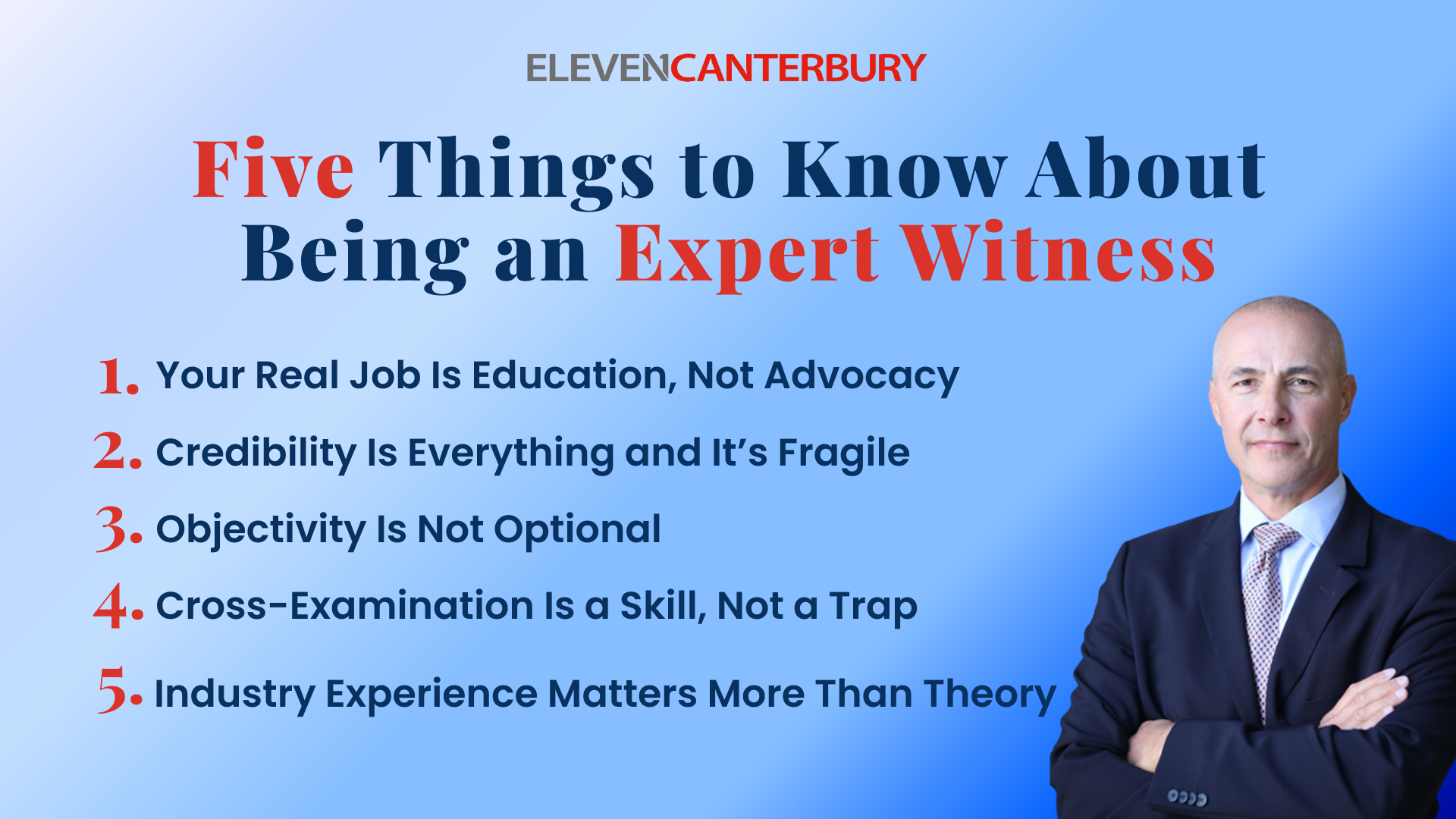
Five Things to Know About Being an Expert Witness
By Cristian Zarcu
Serving as an expert witness is very different from working as an executive leader; it is a distinct professional discipline with its own demands, risks, and standards. After years of testifying in complex, high-stakes litigation, sitting for depositions, and defending opinions under sustained scrutiny, one lesson stands out clearly: credentials may open the door, but they do not carry the day. What ultimately matters in the courtroom is the ability to exercise sound judgment, communicate with precision, and maintain credibility when every word is examined, challenged, and tested.
If you’re considering expert witness work or evaluating whether to retain one, there are five fundamentals that consistently separate effective experts from the rest.
1. Your Job Is Education, Not Advocacy
An expert witness exists to educate the court, not to argue a case. Judges and juries are sharp, attentive, and capable, but they may have little familiarity with the technical, financial, scientific, or operational issues at the center of a dispute. Your responsibility is to translate complexity into clarity.
That means explaining difficult concepts in plain language, without shortcuts, jargon, or performance. Unlike a boardroom, you do not control the conversation. Questions come from counsel, sometimes in pieces and sometimes designed to test precision. The discipline is learning to convey the truth clearly and accurately within that structure, while keeping the focus on the facts.
2. Credibility Is Everything, and It Is Fragile
Credibility is the expert witness’s most valuable asset. It is earned slowly and can be lost quickly.
The way to protect credibility is consistency. Stay anchored to the facts. Remain within your area of expertise. Avoid speculation. Never stretch conclusions to support a narrative. Courts and juries are surprisingly adept at recognizing when testimony is grounded in evidence versus when it is being shaped for effect. Authentic expertise speaks quietly and carries weight.
If an expert witness is seen as a hired gun, someone who appears to favor the side that retained them over objective analysis, their credibility can quickly erode, especially under cross-examination.
3. Objectivity Is Not Optional
One of the most difficult lessons for new expert witnesses is learning when to decline an engagement. If you cannot support the underlying thesis of a case based on the facts and data, walking away is not a failure. It is a professional obligation.
Objectivity also means being prepared to offer opinions that may not perfectly align with counsel’s preferred framing. The strongest legal teams respect this. Your role is to present what the evidence shows, not what would be most convenient. Over time, a reputation for honesty and independence becomes one of the most powerful credentials an expert can have.
4. Cross-Examination Is a Skill, Not a Trap
Cross-examination is not a personal attack. It is a professional exercise, and opposing counsel is doing exactly what they are supposed to do. Questions may be repeated with subtle variations in wording to test consistency or provoke overreach.
The skill lies in listening carefully, answering only what is asked, and resisting the instinct to fill silence or volunteer additional information. Composure matters. Expert testimony is evaluated on substance as well as demeanor. Calm, measured answers reinforce authority. Defensiveness or impatience undermines it.
5. Industry Experience Matters More Than Theory
Real-world experience gives expert witnesses a decisive advantage. Practical exposure allows you to explain how systems or processes function, why they exist, and how they are put into practice. That context is often what courts need most.
Industry experience also enables a broader perspective. It allows you to step back, connect technical details to larger operational realities, and help non-experts understand how individual facts fit into the bigger picture. That ability to move between detail and context is what makes expert testimony resonate.
The Bottom Line
Being an expert witness is demanding, exacting work. It requires integrity, discipline, and a deep respect for the legal process. When done well, it is not about taking sides or winning arguments. It is about helping the court understand complex realities, so informed decisions can be made.
That commitment to clarity and truth is what ultimately separates trusted experts from hired guns.
Cristian Zarcu is an Eleven Canterbury consultant, former Wall Street managing director, and expert in analytic trading and risk management.
For over 8 years, he has supported law firms in complex litigation, high-stakes disputes, and regulatory matters as an experienced expert witness. If you are looking for an expert witness for an active case, upcoming litigation, or pre-litigation evaluation, contact Eleven Canterbury to discuss engaging Cristian or any of our experienced Eleven Canterbury experts: clientservices@elevencanterbury.com